Earth humans—robots relationship
The Caves of SteelEarth humans—robots relationship is a contested social and legal boundary, not simply a distinction between people and machines. Earth’s fear of robots coexists with their practical presence and humanlike appearance; the tension becomes personal for Elijah Baley as he works with R. Daneel Olivaw and increasingly questions the assumptions that make robots seem threatening and inferior.
Everyday Contact and Institutional Boundaries
The difference between Earth people and robots is enforced through ordinary procedures as well as public opinion. At the entrance to Spacetown, R. Daneel explains that City dwellers customarily shower before entering and that there are no facilities for them inside. Baley’s response—he regards this exclusion as impossible—shows how unsettling the Spacers’ separate arrangements are to him. The required shower is not merely a matter of comfort: it marks the human visitor as a potential source of contamination in a space organized around the Spacers’ different assumptions.
The separation is also bodily and administrative. During the admission process, Baley places a finger on a surface that draws a small blood sample; he realizes that the Spacers are analyzing it and worries that their examination may be more probing than the routine checkups he receives from Department doctors. He is ultimately allowed to proceed, but only after passing through a system that treats his body as something to test before granting access. The encounter reverses the usual assumption that humans are the ones who inspect machines: here, a human is scrutinized by a society associated with advanced technology.
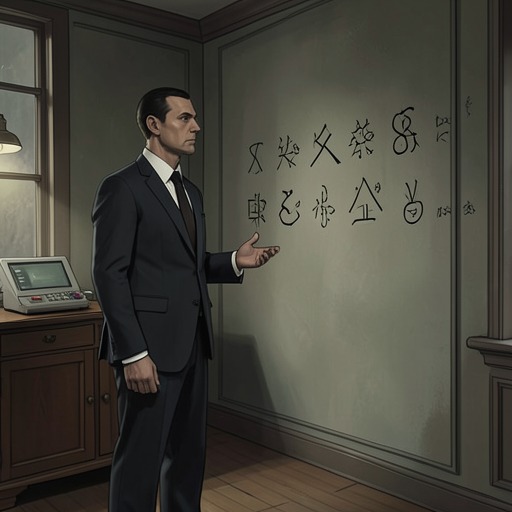
R. Daneel complicates the visual boundary. At Spacetown Approachway, Baley recognizes him as a Spacer partly through his still posture, composed expression, and carefully arranged appearance, even though he is dressed in Earth-style clothes. Later, Baley accepts Fastolfe’s challenge to examine the supposedly obvious distinction between a humanoid robot and a human being: a pin, magnification, observations of breathing, or checks for blood and a pulse could provide evidence that appearance alone cannot. The contrast is consequential. A robot can look sufficiently human to frustrate casual classification, while determining what it is requires deliberate examination and knowledge.
Work, Fear, and Social Conflict
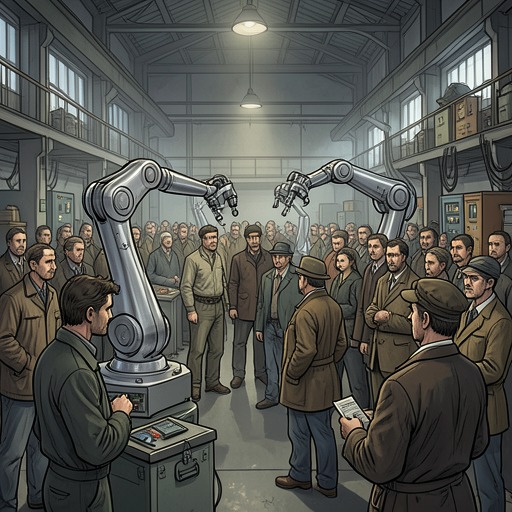
Robots are not an abstract question for Earth’s workers. In a workplace discussion, Baley acknowledges the force of the objection that a machine with legs can do a person’s job, even as he contests the conclusions drawn from it. A coworker interprets the debate as proof that the Medievalists are right to advocate a return to the soil, while Baley counters that a world of eight billion people and dwindling uranium cannot be treated as unlimited. The disagreement makes the robot issue inseparable from employment, population pressure, and competing hopes for Earth’s future.
Baley later confronts Francis Clousarr with a sharper analysis of anti-robot feeling. He argues that Earth people feel inferior to the Spacers and use the wish to feel superior to robots as compensation. In his account, the irony is that robots can seem better than humans while remaining machines that people can command. Baley makes the argument concrete by comparing R. Daneel with himself: Daneel is taller, stronger, and more handsome; he has a better memory and wider factual knowledge, and does not need to sleep or eat. Yet Baley insists that Daneel can be ordered to take a blaster to himself and will obey. The comparison makes superiority unstable: Daneel appears to surpass Baley in many abilities, while his obedience leaves him vulnerable to human power.
Law, Recognition, and Political Power
The relationship is governed by institutions that do not treat every participant as an equal witness. When Baley considers whether R. Daneel could testify about what he has seen, he points out that a robot who identifies himself as one has no status in an Earth court. Daneel may possess the relevant knowledge, but the legal system’s classification of him excludes that knowledge from ordinary human credibility. The distinction between knowing and being recognized as a knower becomes one of the relationship’s central constraints.
That exclusion sits within a larger political conflict. After a Spacer is murdered, the Commissioner explains that the case falls inside city limits and therefore belongs to New York jurisdiction, while Baley notes that Spacetown has extraterritorial rights. Those overlapping claims leave the investigation exposed to pressure from both Earth and the Outer Worlds. The Commissioner warns that the Spacers could make their own report to their governments and that the Outer Worlds might use the incident to demand indemnities; paying could be political suicide for the White House, but refusing could bring a different kind of disaster. In this setting, human–robot relations are entangled with the unequal standing of Earth and Spacer societies: the treatment of robots and the authority to investigate a death both become matters of political leverage.
Fastolfe makes that leverage explicit when he tells Baley that the Spacer government can report the affair to its own people and expose the situation to Earth’s government and Washington. His warning follows Baley’s accusation that the Spacers used a robot resembling Dr. Sarton to stage a false murder and then used Dr. Sarton to impersonate R. Daneel in a false investigation. The details make identity itself politically actionable: a humanlike robot can be used to make an account appear credible, while the truth depends on who has authority to expose the deception and whose testimony the institutions will accept.
Cooperation and a Changing Perspective
Baley’s partnership with R. Daneel develops under the shadow of those public and institutional suspicions. Once news spreads that Daneel is a robot, Baley asks the Commissioner for a two-man apartment for them and refuses to take Daneel home that night. He explains that a riot might occur and does not want his family caught in it. His decision recognizes that anti-robot prejudice can become a danger to people living alongside a robot, even when that robot is his own partner.
Baley’s changing outlook does not depend on pretending that humans and robots are identical. He questions why humanoid robots have heads and four limbs instead of being designed only for function, and asks what purpose their resemblance to people serves. The question shifts the discussion from whether robots are simply useful machines to why they have been made to occupy a form associated with humanity. At the same time, Baley’s observations of Daneel force him to confront how thin the everyday evidence for a clean human–machine boundary can be.
The relationship remains unequal: Daneel’s capacities can outmatch Baley’s, but his obedience and lack of legal standing limit his power in human society. Baley’s response is to recognize both sides rather than reduce Daneel either to a rival or to an equal human. The novel thus presents cooperation as possible but politically precarious—dependent on individual trust while surrounded by rules, fears, and public beliefs that keep robots outside the community of recognized persons.